Design·2026·Self-initiated
Biscuit AI: Telegram Bot Design
01 · The problem
GLM-4.7 is a capable model with real-time web search built in. The problem was the interface: accessing it meant opening a browser, navigating to the platform, and working inside a UI that wasn't designed around how anyone actually works.
That friction is a design problem. Switching contexts to a browser tab, navigating complex web interfaces, losing conversation history, a poor mobile experience. None of this is inevitable. It's just what happens when no one treats the interface as the product.
02 · The shift
Move the model into the app that's already open all day. Telegram is on every device, instant, and familiar. The interface decisions were made in the same order as any other design project: problem first, solution second, implementation last.
Six UX decisions that defined the product:
- Smart pagination: long responses split into navigable chunks. The conversation breathes rather than collapsing under a wall of text.
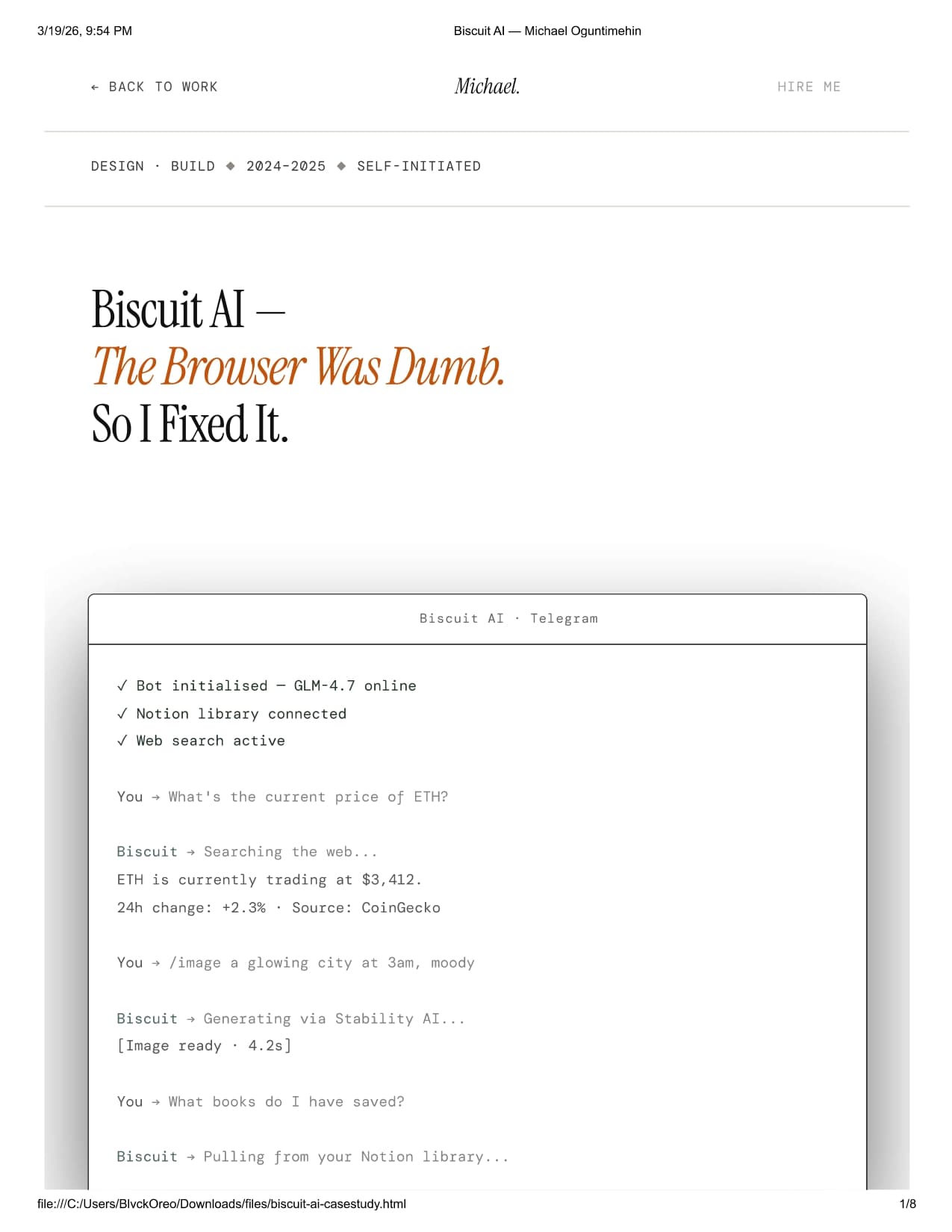
- Natural language triggers: say "books" or "notion" to retrieve your saved library. The interface meets language, not the other way around.
- Honest uncertainty: if the bot can't verify a fact, it says so. Configured deliberately for trust, not just safety.
- Cost visibility: /stats surfaces token usage and estimated cost at any point. Users deserve to know what's happening on their behalf.
- Command architecture: power features behind slash commands. Casual conversation stays conversational.
- Multi-modal integration: image generation, PDF uploads, and web search within the same conversational flow.
03 · Architecture
Every message enters through a single handler router in main.py that classifies intent and routes accordingly: conversational input goes to the LLM router, "books"/"notion" triggers the Notion handler, /image routes to the image handler. The response layer handles pagination, cost tracking, and delivery uniformly regardless of source.
Deployed as a background worker on Render. Async throughout using httpx. No blocking on API calls.
04 · The outcome
A production-ready Telegram bot with intelligent chat, smart pagination, Notion library integration, image generation, and cost visibility. Self-initiated and actively used daily.
The interface decisions were made in the same order as any other design project: problem first, solution second, implementation last. The result is a tool that fits the actual day rather than demanding you reshape the day around the tool.