Design·2026·Birdview Travels & Tours
AI in the Workplace: Employee Training
01 · The problem
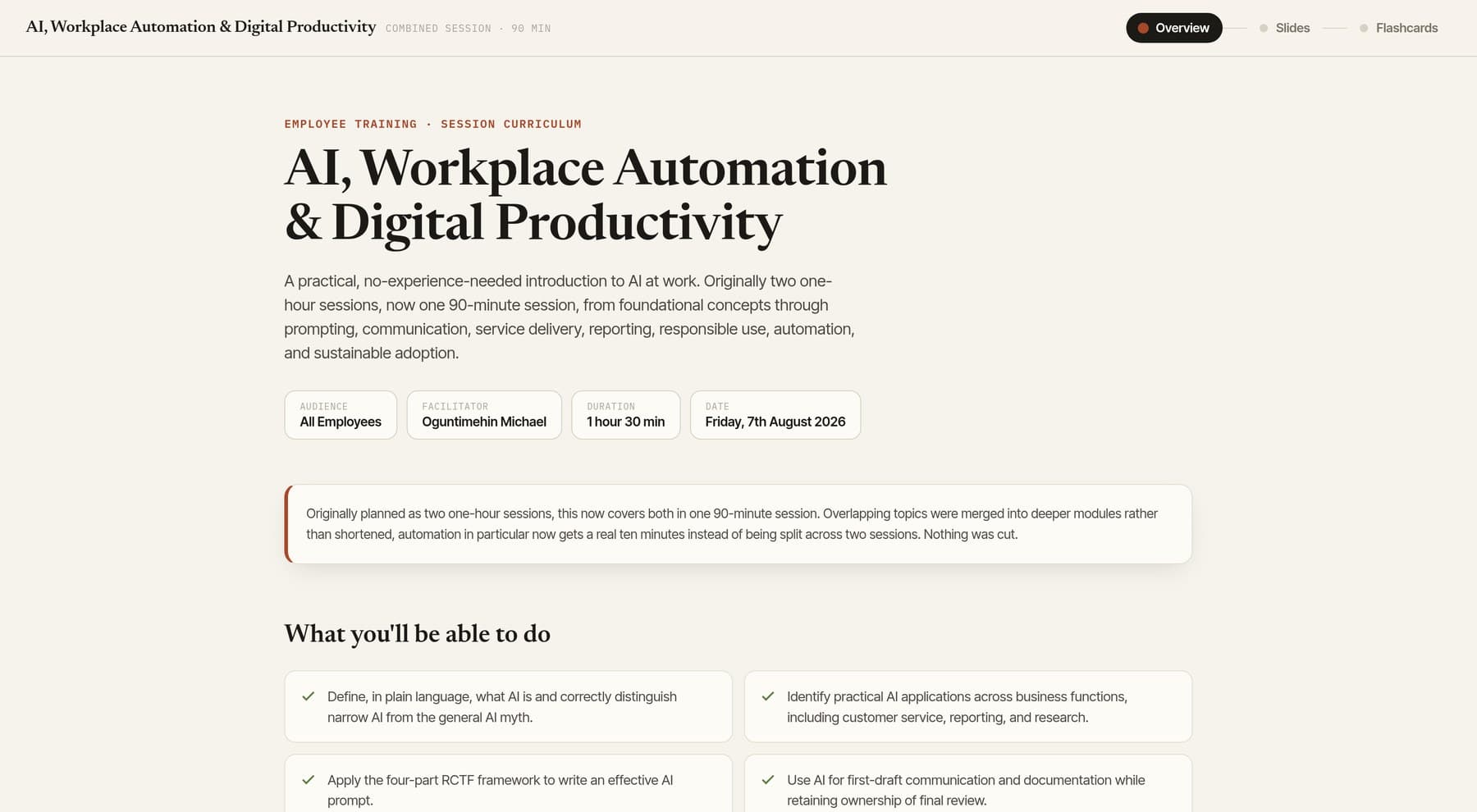
Everyone at work had already heard of AI, and almost nobody had been shown what to actually do with it. The gap wasn't enthusiasm. It was that the available material sat at two useless extremes: breathless posts promising the tools would replace the whole department, or technical explainers written for people who already knew the vocabulary.
What the workforce needed was neither. It was a plain-language starting point, aimed at people with no prior experience, that ended with them doing something differently on Monday morning.
02 · Starting with the Monday talk
The first outing was the weekly Monday talk session, anchored on an introduction to AI. Short, conversational, and deliberately unambitious: one working definition, the difference between the narrow AI that exists and the general AI that doesn't, and the myths worth clearing out before anything useful can be built on top.
That session was the diagnostic. It surfaced what people actually wanted to know, and made the case for a longer, structured programme rather than a one-off talk.
03 · Designing the curriculum
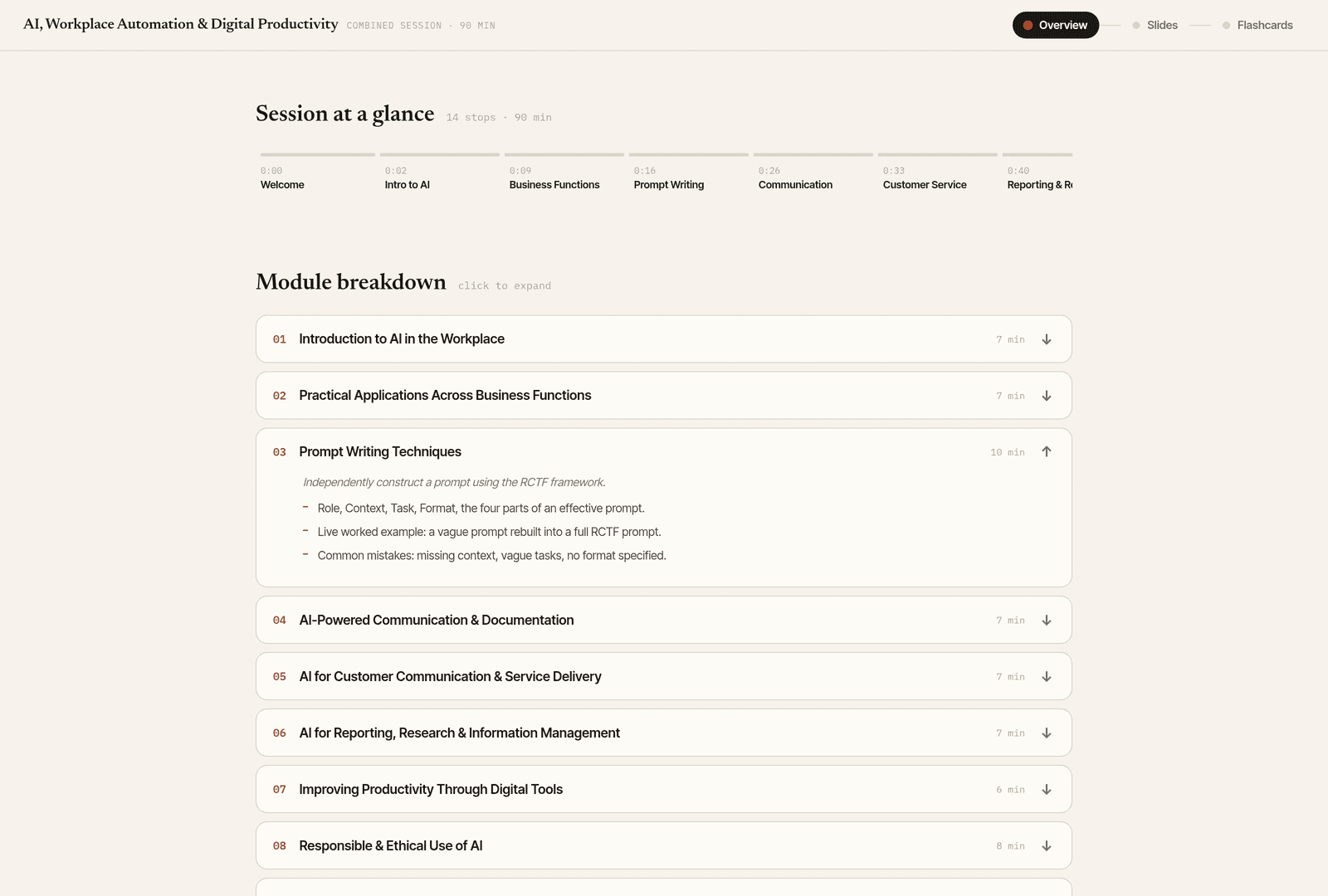
The full programme was scoped as two one-hour sessions, then delivered as one 90-minute session covering both. Overlapping topics were merged into deeper modules rather than shortened, which is how automation ended up with a genuine ten minutes instead of being split thinly across two dates. Nothing was cut.
Eleven modules, each written against a single stated outcome:
- Foundations: what AI is in plain language, narrow versus general, and the myths worth busting.
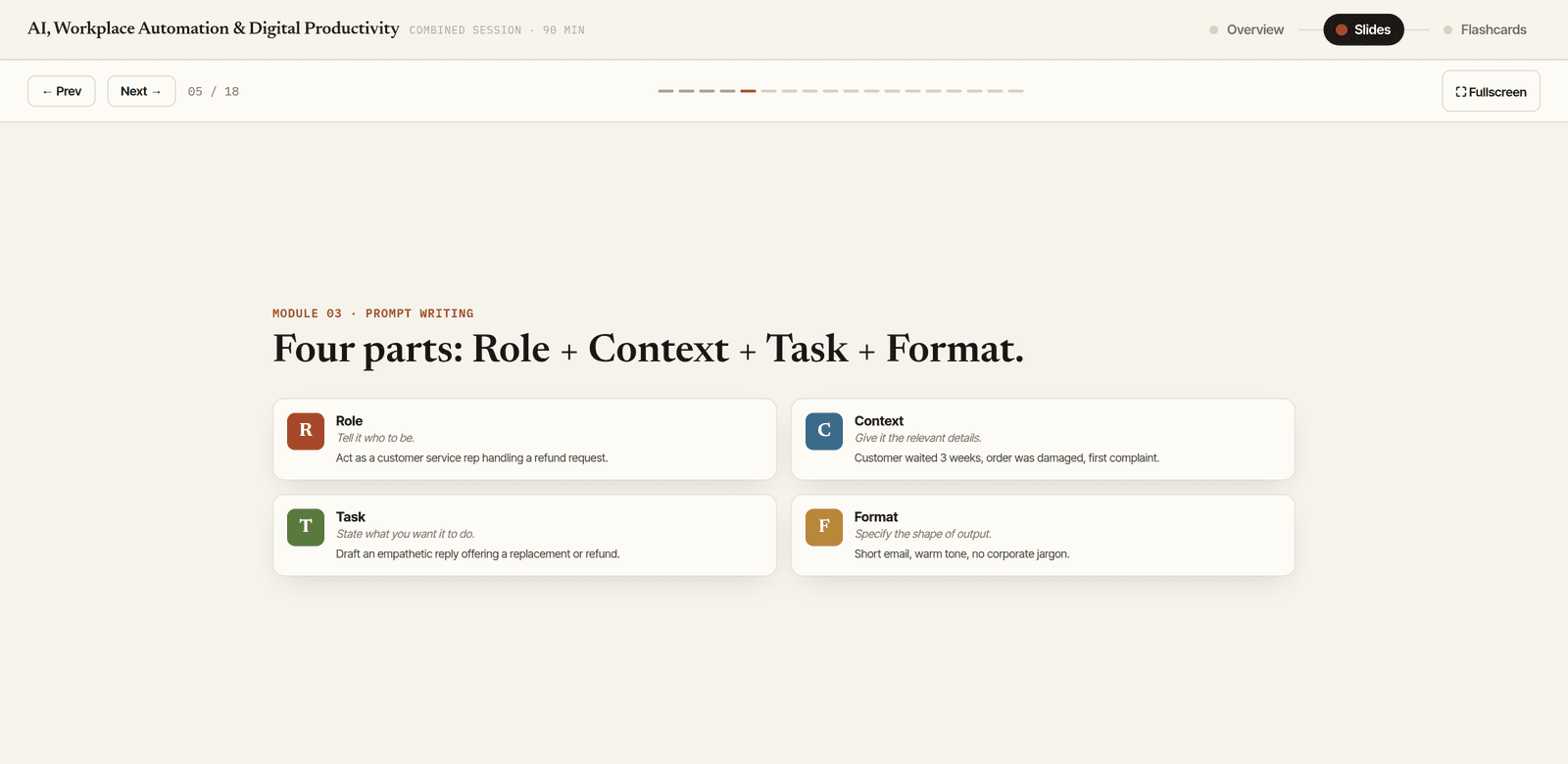
- Prompt writing: the RCTF framework, Role, Context, Task, Format, taught through a vague prompt rebuilt live into a full one.
- Applied work: communication and documentation, customer service delivery, reporting and research, each with the same standing rule that AI drafts and a person finalizes.
- Responsible use: hallucination explained as confident but not certain, plus the three rules on sensitive data, verification, and where accountability sits.
- Automation: the distinction between judgment-based assistance and rule-based action, and the three-part test for a genuine candidate.
- Adoption: daily habits and team practices, because consistency across a team beats individual cleverness.
04 · One link, three modes
Training material normally scatters: a deck in one place, a facilitator guide in another, handouts that go home and get lost. The hub collapses all of it into a single page with three modes, joined by a nav built as a connected path of stops rather than a flat tab bar.
- Overview: objectives, a timed run of the session, and the full module breakdown as an accordion, cross-linked so clicking a point on the timeline opens the module it belongs to.
- Slides: eighteen presentation slides driven by arrow keys with a fullscreen mode, so the same file that documents the session also delivers it.
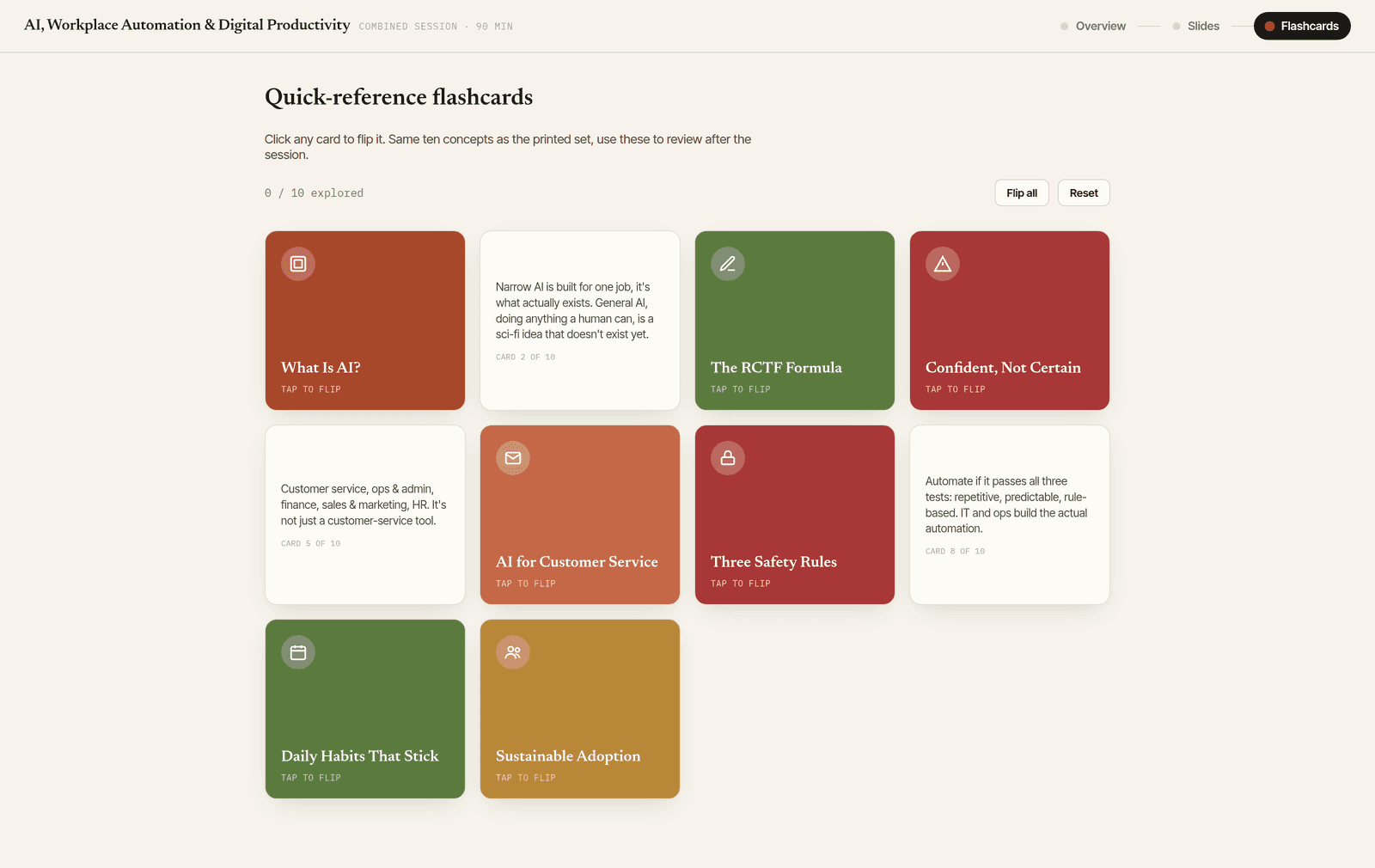
- Flashcards: ten flip cards mirroring the printed set handed out at close, kept online so people can review after the room empties.
Built as one self-contained HTML file with no dependencies and no build step, so it opens from a shared link or a laptop with no wifi, and it will still open in a year.
05 · The outcome
Delivered to all employees on 7 August 2026. The measure of it was never attendance: it was whether people could state the RCTF framework without being prompted, name two AI applications relevant to their own role, and leave with the habit of verifying anything factual or customer-facing before it goes out.
Written, designed, built, and facilitated end to end, the same way as the rest of this portfolio: no handoff, no separate team.
Project images
Next project
DesignSkaame: Artist Web EPK →